


The Health Care Staffing Agency Reporting Act: A Complete Guide for Modern Hiring Compliance
Navigate the critical legislation impacting temporary healthcare staffing, ensure full compliance, and learn how to hire expert clinical staff with confidence using our strategic healthcare workforce solutions.
Navigating the Health Care Staffing Agency Reporting Act
This landmark legislation reshapes transparency and accountability in temporary clinical staffing. Understanding its mandates is non-negotiable for any facility or pharma temp agency operating in today's regulated environment.
What is the Health Care Staffing Agency Reporting Act?
The Health Care Staffing Agency Reporting Act is a pivotal piece of federal legislation designed to bring unprecedented transparency to the temporary healthcare staffing industry. Enacted to address concerns over patient safety, cost inflation, and workforce management during crisis periods like the pandemic, it mandates that staffing agencies report specific operational and financial data to federal and state regulators.
The core intent is to create a national database of staffing agency practices, enabling oversight of pricing, verification of clinician credentials, and tracking of workforce distribution. This ensures that facilities relying on temporary staff—from hospitals to long-term care homes—are partnering with reputable agencies that prioritize compliance as much as national coverage.
Mandatory Reporting Requirements
- Pricing & Cost Structure: Detailed reporting of bill rates charged to healthcare facilities and the corresponding pay rates offered to healthcare personnel, including breakdowns for overtime, hazard pay, and bonuses.
- Staff Credential Verification: Agencies must document and report the process for verifying licenses, certifications, competencies, and background checks for all deployed staff, creating an auditable trail.
- Workforce Data: Aggregate data on the number of staff placed, by specialty and geographic location, to monitor supply and demand trends and potential shortages.
- Complaint & Incident Reporting: Documentation of any formal complaints received from facilities or workers, as well as reportable clinical incidents involving temporary staff.
- Contractual Terms: Submission of standard contract templates used with healthcare facilities, highlighting clauses related to cancellation, minimum hours, and liability.
Impact on Agencies & Healthcare Facilities
For staffing agencies, the Act necessitates significant investment in compliance infrastructure, data management systems, and potentially, a restructuring of pricing models. It elevates operational overhead but also serves as a market differentiator; agencies with robust, transparent practices will be preferred partners.
For healthcare facilities, the Act provides a layer of protection. It empowers procurement teams to make data-driven decisions, comparing agencies not just on cost but on verified compliance and quality metrics. This shift mirrors the strategic approach needed in other sectors, similar to when you seek warehouse safety coordinators where documented safety records are paramount.
Building a Proactive Compliance Strategy
Success under the Health Care Staffing Agency Reporting Act requires a proactive, not reactive, stance. Leading agencies are integrating compliance tracking directly into their recruitment and placement platforms. This ensures real-time data capture on every candidate, from a specialist care nurse to a traveling radiologist. Facilities must update their vendor management protocols to include due diligence checks on an agency's reporting compliance status, treating it as a key performance indicator alongside fill rates and candidate quality.
Expert Insight
Do not view the Reporting Act as mere bureaucracy. Forward-thinking agencies are leveraging the required data transparency as a marketing tool. By showcasing their compliance and superior credentialing processes, they build unparalleled trust with healthcare facilities, leading to longer-term contracts and preferred vendor status. This strategic advantage is as crucial in healthcare as it is in securing expert labour crews for complex construction projects.
Core Benefits of Partnering with a Compliant Staffing Agency
Choosing an agency that not only follows but excels under the Health Care Staffing Agency Reporting Act delivers tangible advantages for your facility's safety, budget, and operational continuity.
Enhanced Patient Safety & Risk Mitigation
The Act's rigorous credential verification mandates mean every nurse, therapist, or aide placed has undergone validated checks. This reduces clinical errors, malpractice risk, and protects your facility's reputation, ensuring the same level of verified safety you'd expect from a dedicated health safety officer.
Cost Transparency & Budgetary Control
With mandated rate reporting, hidden fees and price gouging become impossible. You gain clear insight into staffing costs, allowing for accurate budgeting and financial planning. This transparency is a cornerstone of modern procurement, much like the clear cost structures offered for temporary construction crews.
Strategic Workforce Planning
Access to aggregated workforce data helps predict regional staffing shortages and surpluses. This enables proactive recruitment, reducing last-minute panic hiring and ensuring continuity of care. It's a data-driven approach akin to the strategies outlined in our strategic talent blueprint for 2026.
Operationalizing the Act: A Step-by-Step Framework for Healthcare HR
Implementing the requirements of the Health Care Staffing Agency Reporting Act is a multi-departmental effort. It requires collaboration between HR, procurement, legal, and clinical leadership. Below is a practical framework to ensure seamless integration into your existing vendor management processes.
Step 1: Internal Audit & Gap Analysis
Begin by conducting a thorough audit of your current temporary staffing contracts and agency partnerships. Map existing agreements against the Act's reporting mandates. Identify which agencies already provide transparent data (e.g., detailed invoices, credential packets) and which operate with less visibility. This process is as critical as auditing the qualifications for CSCS labourers on a construction site.
- Review all active staffing agency contracts.
- Catalog the types of data currently received from each agency.
- Identify internal systems for storing and analyzing this data.
Step 2: Vendor Qualification & RFP Updates
Update your Request for Proposal (RFP) templates and vendor qualification checklists to include explicit questions about compliance with the Health Care Staffing Agency Reporting Act. Make it a scored criterion. Prioritize agencies that can demonstrate automated systems for credential verification and reporting, much like you would prioritize a pharma temp agency with validated GMP training records for lab roles.
Key RFP additions should include:"Describe your data management system for tracking and reporting staff credentials, bill rates, and placement metrics as required under federal reporting statutes."
Step 3: Integration & Ongoing Monitoring
Establish a regular review cadence (quarterly or biannually) to monitor agency compliance. Designate a compliance officer within your team to be the point of contact for agency-reported data. Use this data not just for regulatory submission, but for strategic analysis—comparing agency performance, forecasting staffing needs, and negotiating better rates. This level of strategic vendor management is essential across all temporary staffing, from healthcare to securing reliable warehouse staff.
Fast & Compliant Hiring in Action
Understanding complex legislation is one thing; executing a fast, compliant hiring process is another. This video breaks down modern recruitment strategies that align with regulatory transparency while delivering speed.
Need Compliant Staff Fast?
Our platform is built for the era of the Health Care Staffing Agency Reporting Act. We handle the compliance overhead, so you get verified, pre-credentialed staff without delay.
Post Your Job & See Candidates in HoursFrequently Asked Questions: Health Care Staffing Agency Reporting Act
The Act primarily applies to any entity that qualifies as a"health care staffing agency" – defined as an organization that recruits, hires, and places healthcare personnel (e.g., registered nurses, licensed practical nurses, certified nursing assistants, therapists) into temporary work assignments at healthcare facilities. This includes large national firms, regional specialists, and niche agencies like a pharma temp agency placing lab technicians. Some states may have variations, so checking local jurisdiction is crucial.
Penalties can be severe and multi-faceted. They typically include substantial financial fines levied per violation or per day of non-compliance. More critically, agencies can be barred from contracting with federally-funded healthcare facilities (like Medicare/Medicaid participants). State-level penalties may include license suspension or revocation. For healthcare facilities, knowingly contracting with a non-compliant agency could lead to contractual liabilities and jeopardize their own regulatory standing.
In the short term, agencies may pass some of the costs of implementing compliance systems onto clients, potentially causing a slight rate increase. However, the long-term effect is greater cost control and predictability for facilities. The mandated transparency eliminates hidden fees and discourages price gouging during crisis shortages. You gain the ability to compare"all-in" rates between agencies accurately, leading to more competitive pricing and smarter budgeting—a principle that applies whether hiring a professional cleaner or a cardiac nurse.
Yes, a compliant staffing agency's primary role is to manage the data collection, verification, and submission processes required by the Act. However, the healthcare facility retains ultimate responsibility for ensuring its vendors are compliant. Your role is one of due diligence: verifying the agency's reporting processes, auditing the quality of the staff they provide, and maintaining records of your partnership. It's a shared responsibility model, similar to how a general contractor verifies the credentials of a specialist carpentry crew supplied by a subcontractor.
Streamline Your Compliant Healthcare Hiring Today
The Health Care Staffing Agency Reporting Act defines the new standard for quality and transparency. Partner with a platform built for this regulatory landscape. Access a national pool of pre-vetted, credentialed healthcare professionals while we manage the compliance complexity.
Verified Credentials
Every candidate's license, certification, and background check is digitally verified and audit-ready.
Transparent Pricing
Clear, all-inclusive rates with no hidden fees, fully aligned with reporting requirements.
Strategic Partnership
More than just fill-ins, we become an extension of your HR team, ensuring continuity and quality.
Need immediate support? Our compliance specialists are ready to assist. Contact our team now.
Case Study: Transforming Compliance into a Competitive Edge
A regional hospital network's journey illustrates how proactive adaptation to the Reporting Act reduced costs, improved quality, and streamlined operations. This real-world example provides a blueprint for success.
The Challenge: Fragmented Vendors & Rising Costs
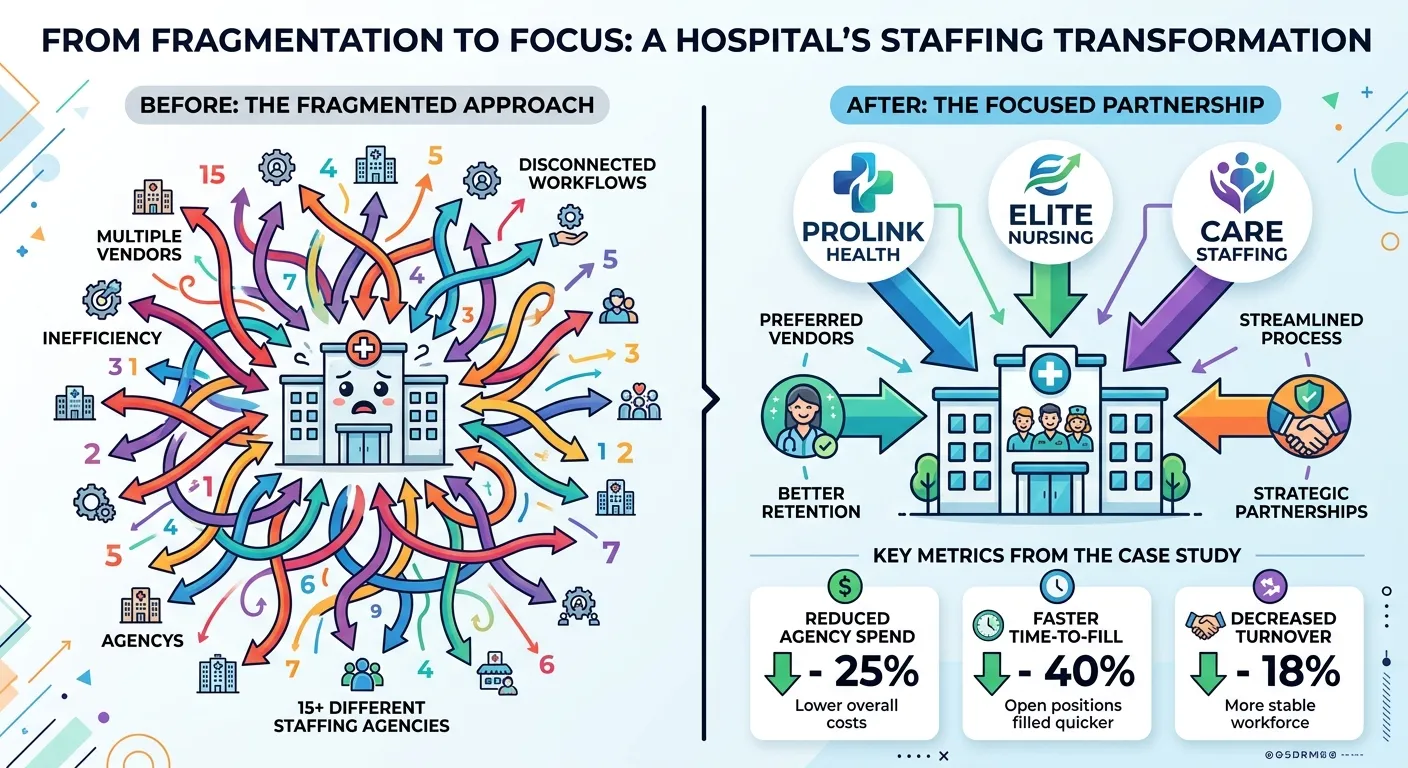
Prior to the Act's implementation,"Midwest Regional Health" worked with over 15 different staffing agencies to fill nursing vacancies across its 7 facilities. There was no standardized credential verification, rates varied wildly between agencies for the same role, and the procurement team spent countless hours reconciling invoices. The lack of transparency made it impossible to identify which agencies were providing the most reliable staff or the best value.
The impending Reporting Act mandates forced a strategic decision: continue with a fragmented, risky approach or use the legislation as a catalyst for a vendor consolidation and standardization program.
The Turning Point
The compliance deadline became an opportunity. The network's COO stated:"We decided to treat the Reporting Act not as a hurdle, but as the perfect RFP criteria to find a true strategic partner, not just a body shop."
Quantifiable Results After 12 Months
Reduced from 15 agencies to 3 primary, fully-compliant partners.
Pre-verified credential pools eliminated 2-3 day verification delays.
Attributed to higher-quality, thoroughly vetted temporary staff.
"The Act gave us the data to make smarter decisions. We now see staffing as a strategic investment in quality, not just a cost center." – Director of Nursing
Implementation Roadmap: Lessons Learned
The hospital network's success was built on a phased approach that other facilities can replicate:
Phase 1: Data-Driven Vendor Assessment
They created a scoring matrix evaluating each existing agency on current compliance posture, data accessibility, and pricing transparency. This objective analysis identified which vendors were already aligned with the new era.
Phase 2: Pilot & Integration
They selected two top-scoring agencies for a 90-day pilot in their largest facility. IT worked to integrate the agencies' compliance data feeds directly into the hospital's vendor management system for real-time monitoring.
Phase 3: Full Rollout & Negotiation
With proven results from the pilot, they negotiated master service agreements with the selected agencies, leveraging the guaranteed compliance and data reporting to secure more favorable, transparent long-term rates.
The Essential Technology Stack for Reporting Act Compliance
Manual processes cannot scale to meet the Act's demands. Compliance is now a technology-driven function. Here are the core systems that leading agencies and facilities are implementing.
1. Automated Credential Verification Platforms
These systems perform real-time checks against primary sources (state licensing boards, certification bodies, OIG exclusion lists). They don't just store a copy of a license; they validate its current status and set automatic alerts for renewals or disciplinary actions.
- Direct Source Integration: APIs connect directly to the National Council of State Boards of Nursing (NCSBN) Nursys® system and other databases.
- Continuous Monitoring: 24/7 surveillance, not just a one-time check at hire.
- Audit Trail Generation: Automatically produces a timestamped report for every verification, perfect for regulatory inspection.
2. Unified Financial & Placement Data Hubs
A single source of truth that links timekeeping, billing, and placement data is critical. This system must generate the specific data sets required for reporting: bill rate vs. pay rate per assignment, specialty, location, and facility.
- Rate Transparency Engines: Clearly defines and reports every component of cost (base rate, overtime multiplier, travel stipends, bonuses).
- Geographic Analytics: Maps staff distribution to identify underserved areas or potential saturation.
- Automated Report Generation: Schedules and formats data submissions to meet state and federal deadlines.
The Integration Imperative
The true power is not in standalone systems, but in their integration. When the credentialing platform talks to the financial hub, an agency can instantly prove that a nurse with a verified ACLS certification was billed at the appropriate specialty rate. This interconnected data fabric is what regulators will expect to see. For healthcare facilities, the ask should be for agencies to provide secure, read-only access to these integrated dashboards, offering real-time visibility rather than retrospective reports.
"The 'compliance tech stack' is now as fundamental to a staffing agency's operations as their ATS. It's the backbone of trust." – Technology Analyst, Healthcare Staffing Institute
Beyond the Act: The Future of Healthcare Staffing Regulation
The Reporting Act is a foundational step, not the final destination. Industry experts predict several regulatory evolutions that agencies and facilities must prepare for now.
Prediction 1: Standardized Quality Metrics & Public Ratings
Much like the CMS Star Ratings for nursing homes, the next logical step is the public aggregation of reported data to create"Staffing Agency Quality Scores." Metrics could include:
- Credential Verification Rate: Percentage of staff with licenses verified from primary sources.
- Facility Satisfaction Score: Aggregated feedback from healthcare facilities on staff performance.
- Contractual Compliance Score: Measuring adherence to agreed-upon fill rates, cancellation policies, and substitute provisions.
These public scores would dramatically shift market dynamics, favoring agencies that invest in quality over those competing solely on speed or cost.
Prediction 2: Interstate Licensure Compact Integration
The Nurse Licensure Compact (NLC) and other interstate agreements simplify multi-state placement. Future regulations will likely require agencies to demonstrate how they track and ensure compliance not just with the compact's rules, but with the specific practice acts of each state a professional works in. The reporting burden will expand to include proof of competency in state-specific protocols (e.g., opioid administration rules in Massachusetts vs. California).
Prediction 3: Direct Impact on Reimbursement Models
CMS and private payers may begin to link facility reimbursement rates to the quality metrics of the temporary staff they employ. A hospital relying heavily on agencies with low public quality scores could see adjustments to its diagnosis-related group (DRG) payments. This would make the choice of staffing partner a direct financial imperative, moving it from an operational decision to a core strategic one with C-suite visibility.
Actionable Advice for Future-Proofing
Start building your processes with these future states in mind. Choose technology partners whose platforms are built for scalability and new data points. Negotiate contracts with agencies that include clauses for adapting to new reporting requirements. By viewing compliance as a continuous journey of improvement, you build resilience and a lasting competitive advantage in the healthcare talent market.
Future-Proof Your Workforce Strategy